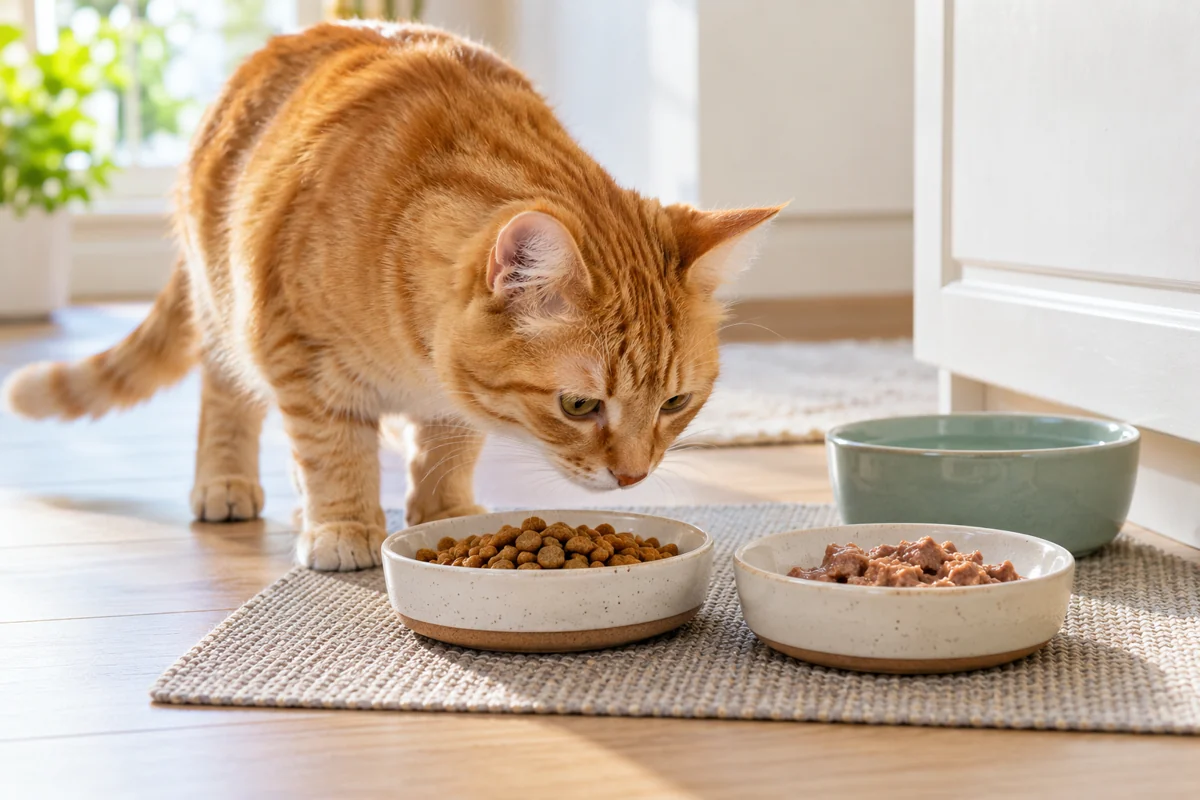
To switch a cat from dry to wet food, first offer a small taste alongside the familiar food. Once your cat accepts it, replace the dry-food calories gradually over about a week, slowing down if needed. Keep your cat eating throughout the change. Never withhold food to make a reluctant cat accept a new diet.
This guide covers the practical transition. For help choosing a diet, see our guide to wet food for indoor cats. Cats with a prescribed diet or a medical condition need a transition plan from their veterinarian.
Table of Contents
Key Takeaways
- Acceptance comes first; the calendar is flexible.
- Replace calories, not equal scoops or spoonfuls. Wet and dry foods have different energy densities.
- Track what your cat actually eats, including both foods and treats.
- Food refusal, illness, or unexpected weight loss calls for veterinary advice.
Before You Start: Choose the Food and Record the Portions
Choose a wet food labeled complete and balanced for your cat’s life stage. A complementary food or treat is not a replacement for the main diet. Wet food contributes water, but fresh drinking water should remain available. Both wet and dry formats can provide complete nutrition; the right choice also depends on what your cat eats reliably.
Write down the current food, daily amount, and calories shown on its packaging. Note the new food’s calories per can, pouch, or gram. If you do not know your cat’s appropriate daily calorie allowance, ask your veterinary team before changing portions. Switching format is not a reason to start calorie restriction.
For an older cat, our senior-cat nutrition guide explains why body condition and medical needs matter more than age marketing.
Let Your Cat Try Wet Food Without Losing a Familiar Meal
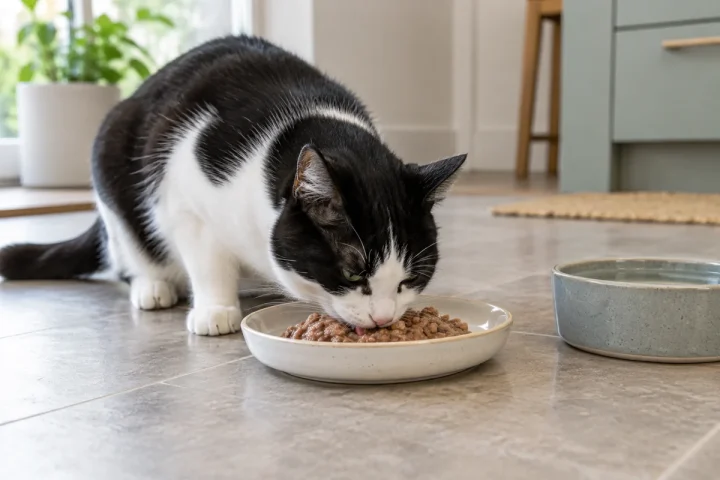
Begin with a small amount in a separate bowl beside the usual meal. This lets you see whether your cat accepts the flavor and texture before changing the familiar food. Count the taste as part of the day’s food allowance once it becomes a regular portion.
A cat that sniffs the new food and walks away has not completed the acceptance step. Keep the familiar diet available and try another small offering later. Change one feature at a time, such as texture, so you can tell what helped. Some cats need a much longer introduction than others.
A Flexible Dry-to-Wet Transition Plan
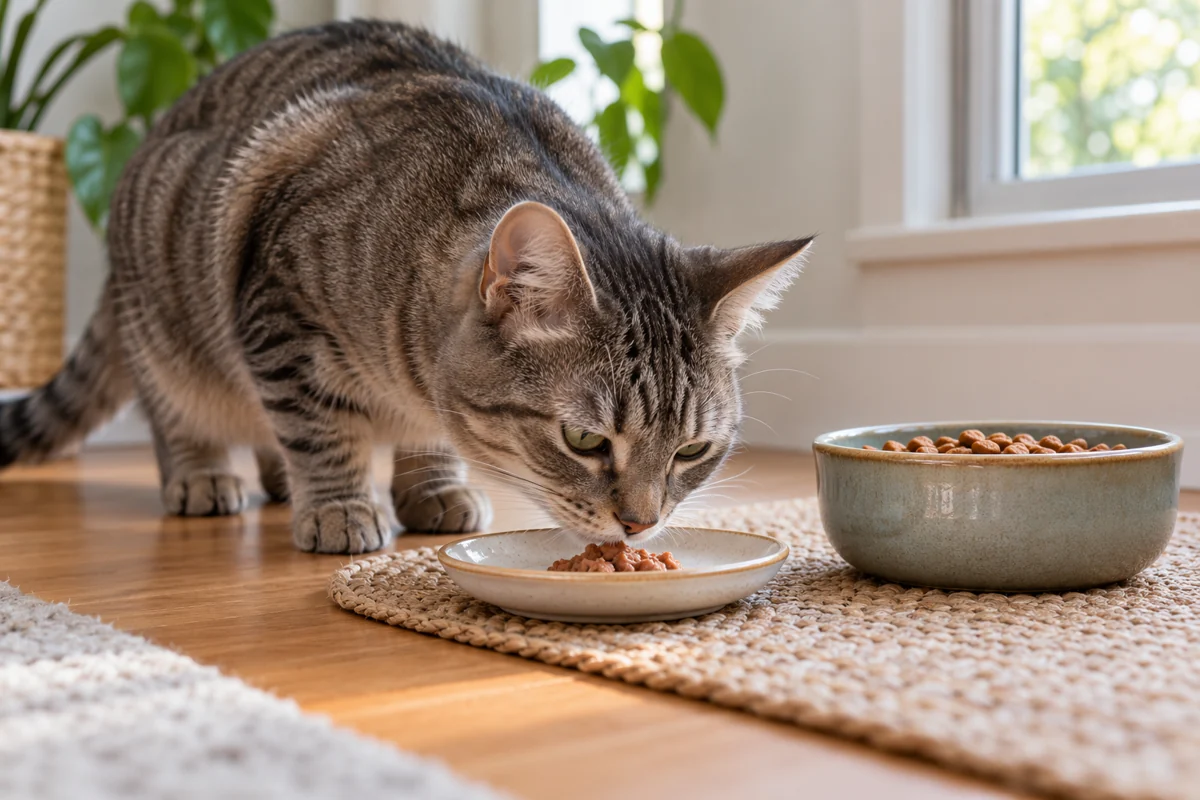
After your cat willingly eats the new food, the following stages are a starting point for an otherwise healthy cat. VCA describes gradual changes over roughly a week, with a slower approach for reluctant cats or those with a history of digestive upset.
- Start small: about 75% of the food calories from the familiar diet and 25% from the new food.
- Move to half: about 50% from each food.
- Make wet food the larger share: about 25% familiar-food calories and 75% new-food calories.
- Complete the change: all main-food calories from the new complete diet, if that is your goal.
Spend around two days at each of the first stages, moving forward only when intake and tolerance are good. These calorie shares are a practical way to apply the gradual proportions when the two foods have different energy densities. They are not a prescribed diet for every cat. A veterinary plan takes precedence.
Replace Calories, Not Equal Volumes
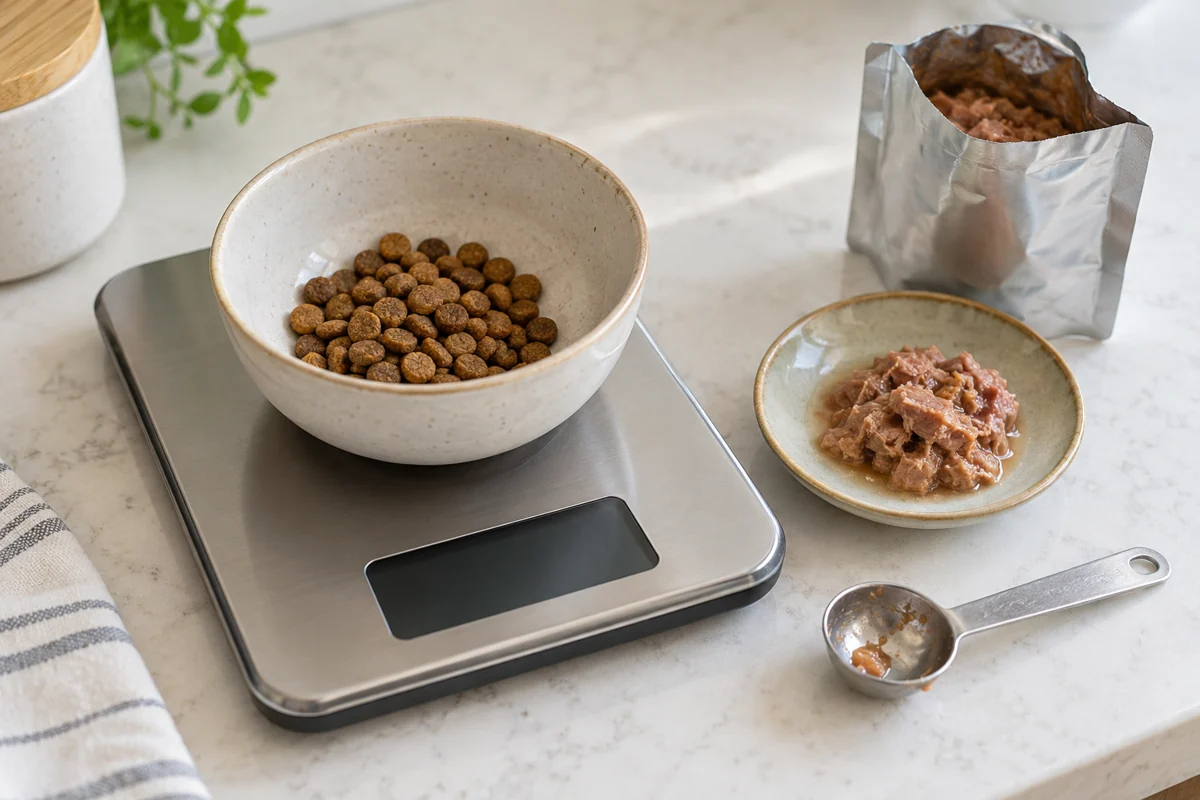
A spoonful of kibble and a spoonful of wet food are not interchangeable portions. Use each label’s energy information to calculate the amount.
Illustrative example only: suppose a veterinarian has already set a 200-kcal daily allowance. At a 25% wet-food stage, that would mean 50 kcal from wet food and 150 kcal from dry food. If the wet food contains 100 kcal per pouch and the dry food contains 4 kcal per gram, the corresponding daily amounts are half a pouch and 37.5 g of dry food.
The 200-kcal figure is not a recommendation for your cat. Substitute the actual allowance and label values, account for treats, and divide the resulting portions among the usual meals. If wet food is left uneaten, your cat has not received those planned calories.
If Your Cat Refuses the New Food
Return to the last accepted step rather than removing all familiar food. You can keep the foods in separate bowls; mixing is not essential if it makes your cat reject both. Offer fresh portions and follow the packaging instructions for serving and storage. Refrigerate unused opened canned food rather than leaving it out as you would kibble. Our wet-food serving and storage guide explains product-specific time limits and how to handle leftovers.
Ask your veterinarian about suitable textures or gently warming a serving if acceptance remains difficult. Avoid repeatedly adding rich treats or human foods to persuade your cat: they change the calorie calculation and may be unsuitable for a prescribed diet.
When to Pause and Contact Your Veterinarian
Contact your veterinarian promptly if your cat stops eating, eats markedly less, vomits repeatedly, develops ongoing diarrhea, or seems unwell. Do not wait through a multi-day transition to see whether complete food refusal resolves. Cornell notes that loss of appetite can harm an adult cat within as little as 24 hours; young kittens can become unwell sooner. Do not force food into your cat’s mouth.
Unplanned weight loss also needs assessment; see why a cat may be losing weight. For kidney disease, a standard wet food is not automatically a substitute for a prescribed renal diet. Work with your veterinarian on the food and pace while protecting food intake.
Common Questions
Does my cat have to switch completely to wet food?
No. Some cats do well with a combination of complete wet and dry foods. The same calorie accounting applies. A prescribed diet may impose different restrictions, so check before combining foods.
What if the transition takes longer than a week?
A longer introduction can be appropriate. Focus on reliable intake rather than meeting a deadline. If acceptance remains poor or symptoms appear, ask your veterinary team for an individual plan.
Can I use this plan for a kitten or a cat with diabetes?
Get a veterinary plan first. Kittens need food suitable for growth, and cats with diabetes or other medical conditions may need coordinated diet and treatment changes. This example is not a medication or disease-management plan.